|
Seldom
publicized except as a sub hunter the famed Catalina flying boat was capable of doing a
lot more than just dropping depth charges… When naming Army Air Force planes of WWII
one automatically recalls "Mustang" and "Thunderbolt" fighters,
"Flying Fortress" and "Liberator" heavy bombers, or
"Mitchell" or "Marauder" mediums but what about "Catalinas"?
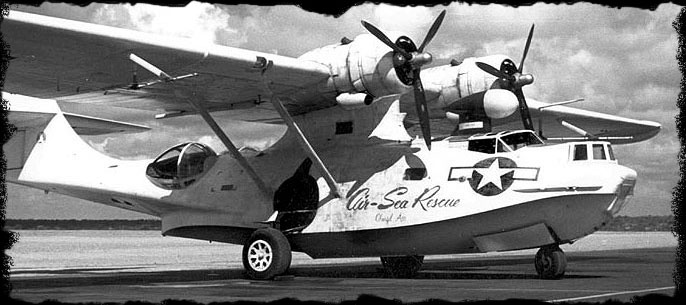
Navy planes you say. Yes, but Army Air Forces too. They were part of a little known and
seldom remembered AAF component - the
Emergency Rescue Squadrons. They served with distinction saving lives in the
Pacific and out of England also. These Vickers OA-10A Catalinas, Canadian built versions
of the Consolidated PBY-5A, were not just there they were in the heart of the action.
Throughout
operations it was the wonderful Catalinas of the Army Air Force that did the yeomen work.
Attached to the 5th Air Force, the cats of the 3rd and 6th
ERS’s did just as much. There were also four other Emergency Rescue Squadrons –
the 4th stationed at Iwo Jima to serve the 20th Air Force, and the 5th
serving with the 8th Air Force in England.
The 1st ERS in the
Mediterranean and the 7th ERS that operated in the CBI (China-Burma-India)
theatre. Fighter and bomber crews were plucked from the endless waters of
the South Pacific, from atolls and from island beaches and returned safely
to their units. In
all, during the war, the Army Cats saved the lives of almost one thousand men. Yet
amazingly, not one of these magnificent squadrons is listed in the official book of the
USAAF combat squadrons! They have really been forgotten – except by those men who owe
their lives to the Army Cats and their crews. Known as the “Snafu Snatchers”
this squadron was the first AAF unit of its kind in the Pacific. In July 1944, it was
assigned to the 5th AF from which it was assigned to the 13th Air
Force in September 1944. Using their OA-10A’s the 2nd
Emergency retrieved close to 700 airmen from death or
capture during its tenure in the Pacific. See their plaque at the U.S.
Air Force Museum!
 HISTORY -
The prototype Catalina first flew on March 28, 1935.
It was produced by Consolidated Aircraft Corporation in both seaplane and amphibious
versions. Catalinas were also produced by
Canadian Vickers, LTD. and the Naval Aircraft Factory. Eventually nearly 2,500 Catalina
derivatives were built for the Navy. Approximately 380 were transferred to the AAF as
OA-10s, OA-10A's, and OA-10B's or in some cases, with their original Navy designations.
Catalinas also were flown by a number of allied nations during and after WWII. From
its introduction to U.S. Naval service in 1936, through its continued international
military use into the 1970's, to the recent retirement of the last civilian fire-bomber,
the Consolidated PBY Catalina has served a distinguished career as one of the
most rugged and versatile aircraft in U.S. history. It was created in response to the U.S.
Navy's 1933 request for a prototype to replace the Consolidated P2Y and the Martin P3M
with a new patrol-bomber flying boat with extended range and greater load capacity.
The Catalina was powered by two Pratt and
Whitney R-1830-92 engines of 1200 Horsepower each. HISTORY -
The prototype Catalina first flew on March 28, 1935.
It was produced by Consolidated Aircraft Corporation in both seaplane and amphibious
versions. Catalinas were also produced by
Canadian Vickers, LTD. and the Naval Aircraft Factory. Eventually nearly 2,500 Catalina
derivatives were built for the Navy. Approximately 380 were transferred to the AAF as
OA-10s, OA-10A's, and OA-10B's or in some cases, with their original Navy designations.
Catalinas also were flown by a number of allied nations during and after WWII. From
its introduction to U.S. Naval service in 1936, through its continued international
military use into the 1970's, to the recent retirement of the last civilian fire-bomber,
the Consolidated PBY Catalina has served a distinguished career as one of the
most rugged and versatile aircraft in U.S. history. It was created in response to the U.S.
Navy's 1933 request for a prototype to replace the Consolidated P2Y and the Martin P3M
with a new patrol-bomber flying boat with extended range and greater load capacity.
The Catalina was powered by two Pratt and
Whitney R-1830-92 engines of 1200 Horsepower each.
The Catalina was created under the guidance of the brilliant aero-engineer Isaac
Macklin Laddon. The new design introduced internal wing bracing, which greatly reduced the
need for drag-producing struts and bracing wires. A significant improvement over its
predecessors, it had a range of 2,545 miles, and a maximum take-off weight of 35,420 lbs.
In 1939 the Navy considered discontinuing its use in favor of proposed replacements. The
Catalina remained in production, however, because of massive orders placed by Britain,
Canada, Australia, France, and the Netherlands. These countries desperately needed
reliable patrol planes in their eleventh-hour preparations for WW II. Far from replacing
the PBY, the Navy placed its largest single order since WW I for an aircraft.
Over
the years, numerous improvements were made to the design.
An amphibious version, the
PBY-5A,
was developed in 1939,
through
the addition of a
retractable tricycle undercarriage. The
PBY-6A
featured hydrodynamic improvements designed by the Naval Aircraft Factory. The Soviet
Union produced a license-built version for their Navy called the GST and powered by Mikulin M-62 radial engines. Boeing
Aircraft of Canada built the PB2B-1 and PB2B-2
("Canso"), and a derivative of the PBY-5A was built by Canadian Vickers. In US
Army Air Force service, the aircraft was known as the OA-10A (PBY-5A) and
OA-10B (PBY-6A). The Royal Air Force's Coastal Command
flew Catalinas under the designations
Catalina Mk I/II/III/IV.
Because of their worldwide popularity, there was
scarcely a maritime battle in WW II in which they were not involved.
The PBY had its vulnerabilities: it was slow, with a maximum speed of
180 mph, and with no crew armor or self-sealing tanks, it was highly vulnerable to
anti-aircraft attack. However it was these weaknesses, coincident with the development of
effective radar, and Japanese reliance on night transport, which led to the development of
the "Black Cat Squadrons." These crews performed nighttime search
and attack missions in their black-painted PBYs.
The tactics were spectacularly successful and
seriously disrupted the flow of supplies and personnel to Japanese
island bases. [Top]
|
The Catalinas also
proved effective in search and rescue missions, code-named "Dumbo." Small detachments (normally of three
PBY's) routinely orbited on stand-by near targeted combat areas.
One detachment based in the Solomon Islands rescued 161 airmen between January 1 and
August 15, 1943, and successes increased steadily as equipment and tactics improved. After
WW II, the PBY continued its search and rescue service in many Central and South American
countries, as well as in Denmark, until the 1970's.
The Catalina has
also proved useful in civilian service: in scheduled passenger flights in Alaska and the
Caribbean, in geophysical survey, and mostly, in fire-bombing for the U.S. Forest Service
until the recent retirement of the last PBY. Through its long and varied service, the
Consolidated PBY Catalina has earned its reputation as the workhorse of naval aviation.
The PBY Catalina got
its name from the British who used it extensively during WW2 after the United States
delivered a large quantity via the lend-lease program which was instituted before the
United States entered the war. The lend lease program allowed war materials to be provided
to embattled Britain and later Russia, with payment due at a later time. The British, who
at the time were hard pressed for equipment and money, owe much to the lend lease program.
As for the PBY designation, P is for
patrol, B is
for
bomber, Y is the USA military designation for the
manufacturer,
Consolidated. The PBY was made in 7 major versions and produced over a
considerable period of time from the 30’s thru the 40’s and continues to be
actively used by civilian organizations for a variety of purposes even today. The PBY-6,
which was the final version of the PBY was a twin engine amphibian with 2 Wright R1830 18
cylinder engines capable of manifesting 1200 horse power (T.O.) and a maximum speed of
between 175 and 195 miles an hour. (depending on sub variant and configuration)
The typical cruising
speed of the PBY was 100 to 120 miles per hour. The aircraft had an enormous range and
loitering capability with an over all range from 2,500 to 2,900 miles and a service
ceiling of 15,000 to 22,400 feet. The PBY is a large high wing
monoplane with a total wingspan of 104 ft. and a total wing area of 14,000 square feet.
The aircraft measures in at 63 feet 10 inches and has a gross weight of 31,800 pounds to
36,000 pounds. The PBY-6 also came equipped with a radar array fitted in a tear drop
shaped pod above and just behind the cockpit. While the Catalina’s came with a wide
variety of weapons positions and capabilities, the standard armament was a semi flexible
.50 caliber machine gun in each dorsal blister firing from removable drums of ammunition,
a semi flexible .50 caliber machine gun in a tunnel gun facing aft and down and a forward
.30 mounted in a revolving turret in the nose, just below the cockpit wind screen. The
Catalina also carried hard points under the wings for a variety of weapons including but
not limited to aerial torpedoes, depth charges and a variety of bombs. Some of the variety
of other armaments the PBY was fitted with included the replacement of the front turret
with a more aerodynamic turret firing 1 or 2 .50 caliber machine guns, giving the forward
armament considerably harder punch. Also the dorsal guns, which where fitted in large
teardrop shaped glass blisters, where sometimes fitted with an impressive twin .50 caliber
machine gun system, giving heavy side and rear area coverage.
One problem the
consistently plagued the slow and unmanageable aircraft was the large dorsal blisters.
Since the dorsal guns fired canisters instead of belted ammunition, the gunner was
required to travel up to the next compartment to bring back a new canister, since the guns
were in large glass blisters, the pilots of attacking fighters could actually see when the
gunners would run out of ammo and would attack as the gunner went forward to get more
ammo. This was sometimes remedied by replacing the canister guns with guns capable of
firing belts of ammo, but the problem still persisted as a wary fighter pilot could see
when the gunners belt expired and would attack as he loaded a new one. The early
PBY's were very different than the PBY-5 and 6 models which came later and saw so much
service in the Second World War. The original PBY's had no landing gear and were strictly
flying boats. They could be brought on shore by adding beaching gear, a set of removable
wheels. The early PBY's was primarily serviced by ships called seaplane tenders that could
lift the plane out of the water and bring it on board for service. The early PBY’s
also did not have dorsal blisters but instead had small windows that could be pulled back
exposing the gun and the pilot to the air stream. The PBY's’ primary goal was
maritime patrol and anti shipping, although as the war developed it was quickly show to be
very vulnerable to air attacks and anti aircraft artillery and ceased heavy bombing and
anti shipping attacks because of massive losses. However the PBY's initial work as a
patrol aircraft was to prove invaluable as the aircraft took part in almost every major
sea battle in the early part of the war. It was responsible for sighting the Bismarck and
leading to its eventual destruction, for spotting the Japanese fleets at both Midway and
Wake Island and a variety of other critical battles. See the
CUTAWAY
CATALINA at the Naval Aviation Museum in
Pensacola, Florida.
|